
Many Western travelers view haggling as an uncomfortable conflict, but in Vietnam, it is actually a social dance. Bargaining in Vietnam is about human connection, humor, and mutual agreement, not just about saving a few dollars.
When a vendor quotes a high price, they aren’t trying to scam you; they are inviting you to play a game. Understanding this cultural nuance is the key to enjoying your trip. Instead of feeling guilty or stressed, you can learn to see negotiation as a way to interact with locals.
From the “morning luck” superstition to the power of a smile, we will show you how to haggle respectfully and walk away with both a bargain and a story.
Table of Contents
Is bargaining acceptable in Vietnam? (Understanding the Culture)
First things first: remove the guilt.
In many Western countries, the price on the sticker is the price you pay. Arguing about it would be seen as cheap or disrespectful.
But in Vietnam, the market culture is built on negotiation. When a vendor quotes a price to a foreigner, they usually build in a “buffer” specifically for haggling.
If you accept the first price offered, two things happen:
- You overpay significantly (sometimes by 200% or 300%).
- The vendor might actually be confused why you didn’t play the game.
Bargaining in Vietnam is not a conflict; it is an interaction. Think of it less like a battle and more like a friendly tennis match. You hit the ball (price) back and forth until you both agree on a winner. As long as you keep a smile on your face, you aren’t being rude – you are being a local.
Where to bargain (and Where not to)
One of the quickest ways to look like a confused “Tay Balo” (Western Backpacker) is trying to haggle in the wrong place. Imagine trying to negotiate the price of a Big Mac at McDonald’s – it’s just not done.
Here is your cheat sheet on where to unleash your negotiation skills:
Where to bargain
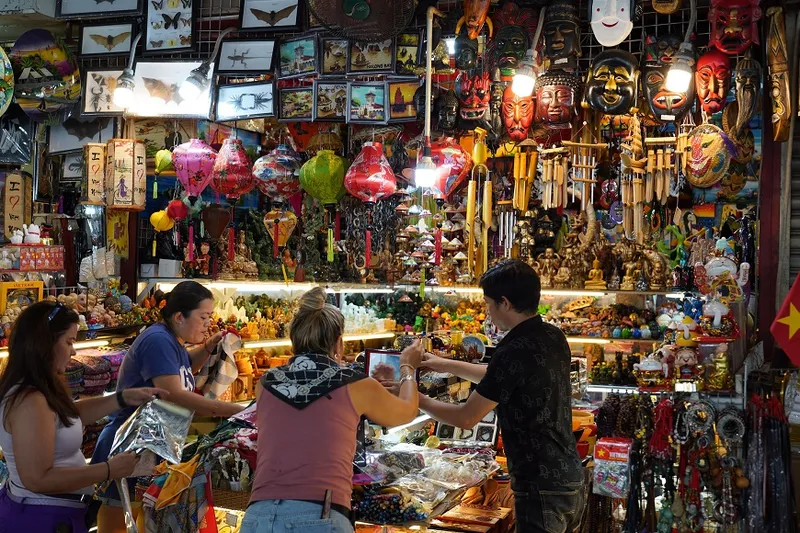
- Traditional Markets: Ben Thanh (HCMC), Dong Xuan (Hanoi), Han Market (Da Nang), and all local wet markets.
- Street Vendors: People selling sunglasses, books, coconuts, or souvenirs on the sidewalk.
- Souvenir Shops: Unless it says “Fixed Price” clearly on the door or items have printed price tags.
- Cyclos and Xe Om: Independent motorbike taxis and bicycle rickshaws must be negotiated before you get in.
- Guest Houses/Hostels: Sometimes negotiable if you are staying long-term (e.g., a month) or booking for a large group.
Where not to bargain
- Convenience Stores: Circle K, 7-Eleven, WinMart. The price on the shelf is final.
- Restaurants & Cafes: If there is a printed menu, you pay what is written.
- Ride-Hailing Apps: Grab, Be, and Gojek have fixed algorithms. Don’t try to haggle with the driver.
- Shopping Malls: High-end stores in Vincom or Takashimaya are fixed price.
- Pharmacies: Medicine prices are generally set.

Preparation: Know the “Real” price before you ask
Knowledge is power. If you walk into a shop and ask “How much?” without having a clue what the item is worth, you have already lost the upper hand. Successful bargaining in Vietnam starts before you even open your mouth.
The 50-70% Rule
As a general rule of thumb, the opening price given to a tourist is often 50% to 70% higher than the actual selling price. Sometimes, for items like “branded” sneakers or bags, it can be triple the real value. Understanding this inflation helps you stay calm when you hear a ridiculous number.
Scouting the Terrain
Never buy at the first stall you see. In markets like Ben Thanh, there are twenty stalls selling the exact same “Good Morning Vietnam” tank top.
- Ask the price at Stall A.
- Say “Thanks” and walk away.
- Ask at Stall B.
- By Stall C, you will have a baseline average.
The Hostel Hack
This is the ultimate backpacker trick. Before you head out shopping, ask the receptionist at your hostel: “How much should I pay for a conical hat?” or “What’s a fair price for a motorbike rental per day?”
Locals know the local price. Armed with this number, you can bargain with confidence because you know where the finish line should be.
The step-by-step bargaining strategy
Ready to play? Here is your step-by-step game plan on how to bargain in Vietnam.
Step 1: The “Poker face”
You see a handcrafted leather bag. You love it, you need it. If the vendor sees your eyes light up, the price just went up. Approach the item casually.
Pick up a few other things you don’t want first. Look at the item you want with mild interest, maybe point out a loose thread or a scratch (even if it’s tiny). Act like you could take it or leave it.
Step 2: The anchor price
- Vendor: “Hello! Good quality, buy for me? 500,000 VND.”
- You: (Look shocked, but friendly) “Oh wow, too expensive! 500k? No way.”
- Vendor: “Okay, okay, discount for you. 400,000.”
Now you make your offer. A good starting point is usually about 40-50% of their opening offer.
You: “I can do 200,000.”
Step 3: The “Ping-Pong” negotiation
They will laugh, shake their head, or pretend to be offended (it’s all part of the act). They will come down a bit; you go up a bit.
- Vendor: “200k? I die! I cannot feed my baby. 350,000.”
- You: “I’m a student! I have no money. 250,000.”
- Vendor: “300,000. Last price.”
Step 4: The ultimate weapon – The “Walk away”
If you are stuck and they won’t come down to your target price (let’s say 270,000), it’s time for the strongest move in your arsenal. Say: “Thank you, that’s too much for me.” Then, slowly turn around and walk away. This is the moment of truth.
90% of the time, if your price was reasonable, they will shout after you: “Okay, okay! Come back! 270,000!”
If they don’t call you back, it means your price was actually too low (below their cost). You can always circle back later and pay their last offer if you really want it.
Pro tips for backpackers to win the deal
Want to level up? Here are the unspoken rules and tips that separate the tourists from the travelers when bargaining in Vietnam.
The “Morning Luck” (Mở hàng) superstition
Vietnamese business culture is deeply spiritual. The first customer of the day determines the luck for the rest of the day.
- The Opportunity: If you shop early in the morning (around 7:00 – 8:00 AM) and you are the first customer, the vendor might give you a huge discount just to make a sale quickly and let the “luck” flow in.
- The Warning: If you bargain hard early in the morning, agree on a price, and then walk away without buying, it is considered incredibly bad luck and rude. The vendor might get genuinely angry. Only haggle in the morning if you intend to buy!
Bargain in Vietnamese
Nothing disarms a vendor faster than a foreigner speaking their language. It shows respect and implies you’ve been here long enough to know the real prices.
Here are your magic phrases (with pronunciation):
- Too expensive! = Đắt quá!
- Oh my god! = Trời ơi!
- Discount please! = Bớt đi!
- 1, 2, 3 = Một, Hai, Ba – Useful for quantities.
Imagine the vendor’s face when they say “500,000” and you reply with a dramatic “Trời ơi! Đắt quá! Bớt đi cô ơi!” (Oh god! Too expensive! Discount please, miss!). You will almost certainly get a smile and a better price.
Watch out for the “Zero” confusion
Vietnamese currency (VND) has a lot of zeros. The 20,000 VND bill (blue) looks somewhat similar to the 500,000 VND bill (also blue-ish). The 10,000 VND looks a bit like the 200,000 VND.
Scammers sometimes rely on tourists getting confused.
- Tip: Always double-check the zeros before handing over cash.
- Tip: When bargaining, clarify if they mean “Thirty” (30,000) or “Three Hundred” (300,000).
Common scenarios: How to haggle for specific services
Different situations require different tactics. Here is how to handle the most common backpacker scenarios.
Motorbike rentals
Different situations in Vietnam call for different negotiation tactics, so understanding the nuance of each service is key to saving money.
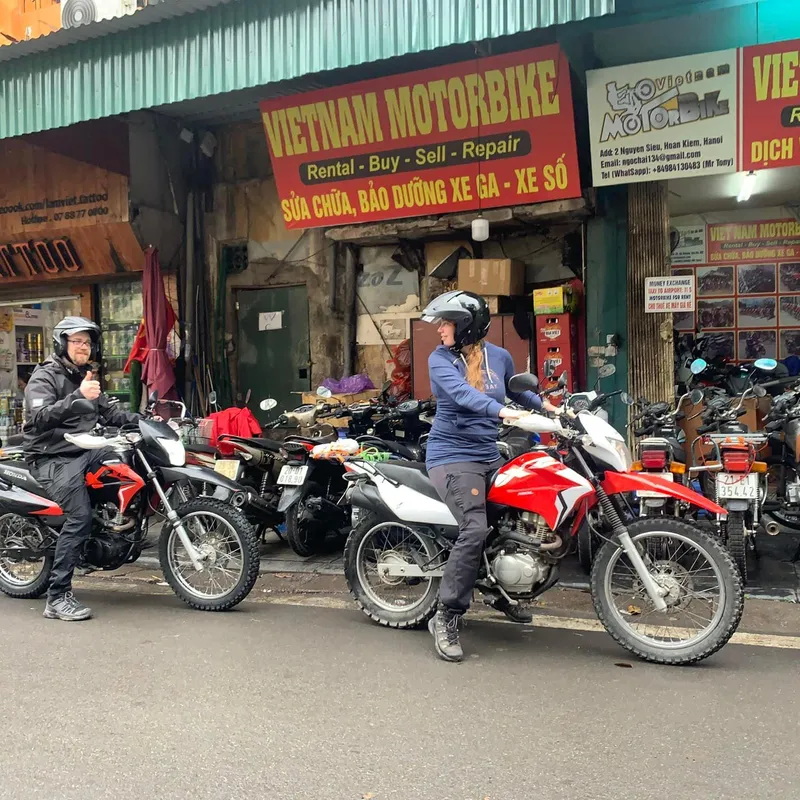
When it comes to motorbike rentals, daily rates for automatic scooters are usually standard (around 150,000 to 200,000 VND), so haggling for a single day might not yield much success.
However, the dynamics change completely if you are planning a longer adventure, like a month-long trip from Hanoi to Saigon. In this case, always negotiate for a long-term discount.
You can also leverage the power of numbers; if you are traveling with a squad, ask for a “group rate” for renting multiple bikes. Offering to pay the full amount upfront in cash is another powerful card to play, often convincing the owner to drop the daily rate significantly.
Cyclops and street taxis (xe om)
Navigating traditional transport like Cyclos (bicycle rickshaws) and independent Xe Om (motorbike taxi) drivers requires a stricter approach because this is where miscommunication – or scams – most often occur.
The golden rule here is to absolutely never hop on or let them touch your luggage without agreeing on a fixed price first.
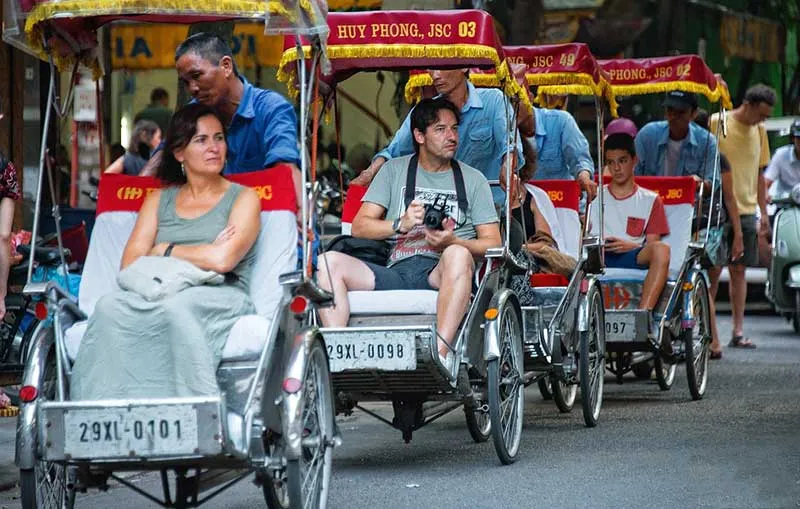
To ensure you aren’t being quoted a “tourist special,” use technology to your advantage. Open a ride-hailing app like Grab or Be to check the standard fare for your route.
Use this number as your bargaining anchor; if the app says 30,000 VND, offer the street driver 40,000 VND. It’s a fair compromise that gives them a bit more than the app but keeps you from paying ten times the actual value.
Clothes and souvenirs
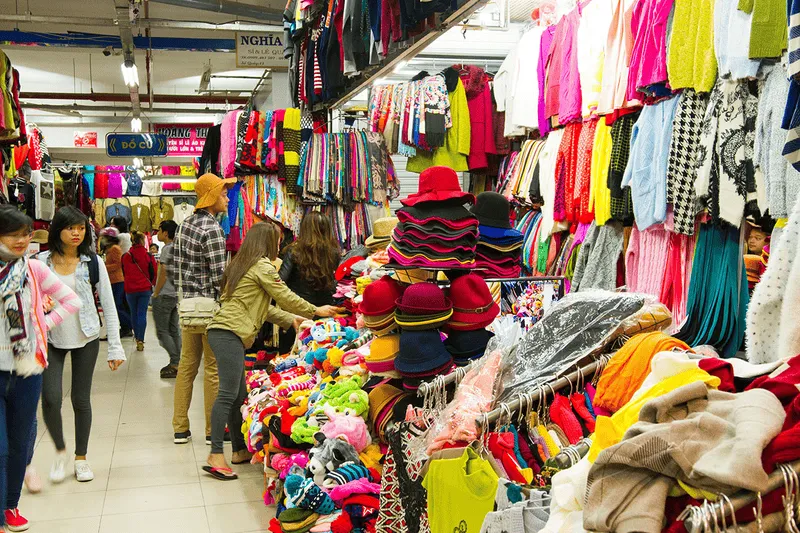
When shopping for clothes or souvenirs at markets, the strategy shifts from individual pricing to volume. It is often difficult to haggle significantly on a single cheap item like a fridge magnet or a string bracelet because the margin is already low.
Instead, aim for a “volume discount.” Vendors are much more willing to lower their prices if they can move more inventory at once.
For instance, if a tank top is quoted at 100,000 VND, try negotiating a deal like “200,000 VND for three.” It is a classic win-win situation: you sort out gifts for your friends back home at a steal, and the vendor gets a quick, substantial sale without spending all day arguing over pennies.
Attitude matters: Be friendly and humorous
This is the most important section of this guide.
It is easy to get caught up in the game and become aggressive, fighting over every last 5,000 VND (which is like… $0.20 USD). Please, don’t be that tourist.
Bargaining in Vietnam should be fun. Use humor. Smile. Joke about being a “poor backpacker.” Compliment their shop. If the vendor likes you, they are more likely to give you a “friendship price.”
Perspective Check:
If you are fighting for 10 minutes to lower the price from 50,000 VND to 40,000 VND, ask yourself: Is this 10,000 VND ($0.40) worth the stress? To you, it’s less than half a cup of coffee.
To the vendor, it might be a bowl of Pho for their lunch.Know when you have reached a fair price, and be happy with it. Don’t squeeze the locals until they make zero profit.
Remember you are a customer (and a guest)
Ultimately, you have the power. If a vendor is being rude, aggressive, or trying to physically grab your arm (it happens rarely, but it happens), you have the right to leave. You are never obligated to buy just because you asked the price.
However, act as a guest. Be polite. If you can’t agree on a price, say “Cảm ơn” (Thank you) with a smile and walk away. Usually, there is another stall five meters away selling the exact same thing.
Bargaining in Vietnam is one of those travel skills that feels awkward at first but quickly becomes addictive. It forces you to interact, to look people in the eye, and to communicate across language barriers.
The next time you are in Hoi An getting a suit tailored, or in Sapa buying a bracelet from a Hmong villager, remember: Do your research, keep your cool, use a little Vietnamese, and most importantly, keep it light-hearted.
You might not just walk away with a bargain; you might walk away with a great story and a new local friend.
Now, go out there and get that “I Love Pho” t-shirt for a price you can brag about!

